Limits to Growth
Carrying capacity, tragedy of the commons and the role of innovation
It might surprise many, but the idea that resources at our civilization’s disposal are not infinite is a rather recent development. For most of civilization’s history, humans just assumed they were limitless. However, these limits became apparent as the second half of the 20th century rolled in, and the world underwent a rapid transformation.
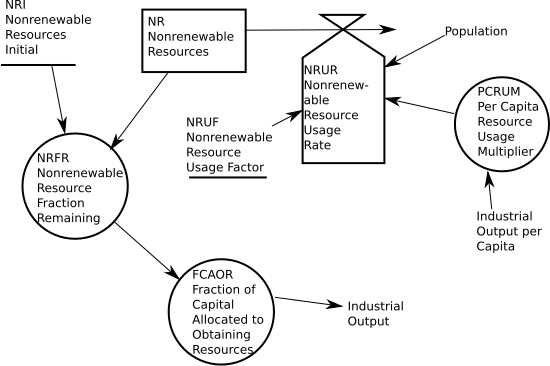
The first time the idea gained widespread exposure was in the Limits to Growth Report by Donella Meadows1 and her fellow researchers at MIT in the 70s. It caused controversy at the time but opened a new way of thinking. A fundamental element of the report is the visual representation of the projections into the future of the world3 model2 (I hosted a version of this on studyofprogress.org, where you can play around with the parameters and see the differences in outcome). In terms of resources, it has aimed to make a best-guess estimate of the relationship between industrial output, consumption, and resources:
It also tracked some of the most relevant parameters for human civilization into the future, such as industrial output, population, and others:
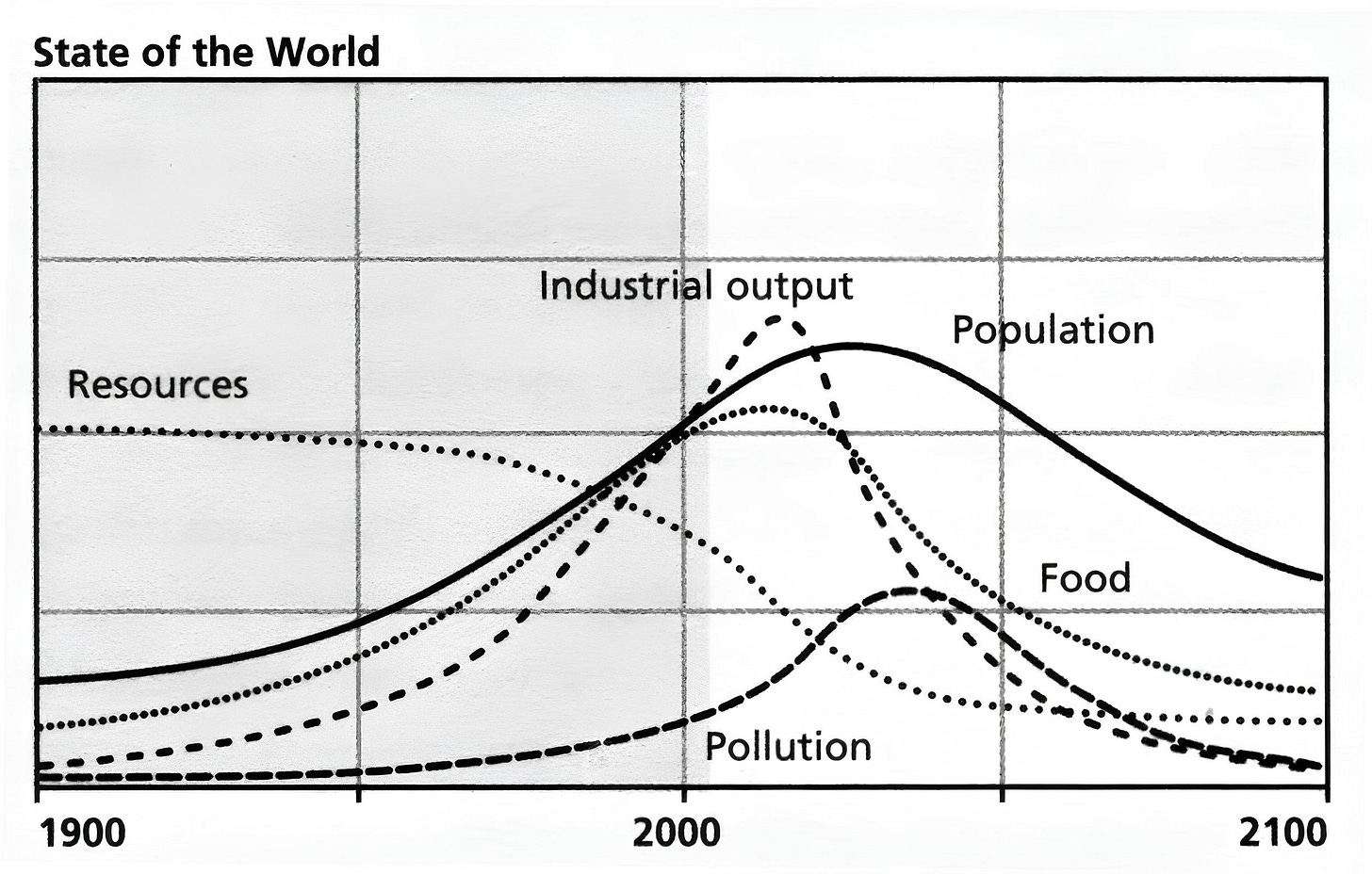
The report was heavily based on systems thinking and approached the problem holistically. The results have mostly been confirmed with time and remain on track, as evidenced in two subsequent updates (1992 and 2004)3. It further proves that we live on a limited planet where fundamental resources eventually run out. The issues go beyond high-energy-yielding compounds such as oil but vital hardware elements that much of our modern infrastructure, such as rare earth metals. It is estimated that we would need 4.9 earths to satisfy global resource demand on the same level as a resident of the USA. We are beyond what our planet can handle—its carrying capacity.
We need to “refactor” our economies and societies - to make them more efficient in turning energy into good things for us while avoiding environmental costs. Several ideas have been proposed as a solution, most notably the de-growth movement. Unfortunately, there has been limited research on practical implementation and whether the proposed measures will work as desired and expected - and decouple environmental damage and economic growth.
Now we come to the problem: any complex system (and our resource-based economy's interaction with its environment is undoubtedly one) will eventually correct itself, ignoring our best interests and desires. This is “the tragedy of the commons” in the complexity community. It was based on an idea in a pamphlet discussing issues with overgrazing of farmland:
Therein is the tragedy. Each man is locked into a system that compels him to increase his herd without limit – in a world that is limited. Ruin is the destination toward which all men rush, each pursuing his own best interest in a society that believes in the freedom of the commons. Freedom in a commons brings ruin to all.
— Garrett Hardin, The Tragedy of the Commons
We can visualize it like this (with system dynamics symbols and loops, which I’ll explain soon, but the primary relationships should be apparent):
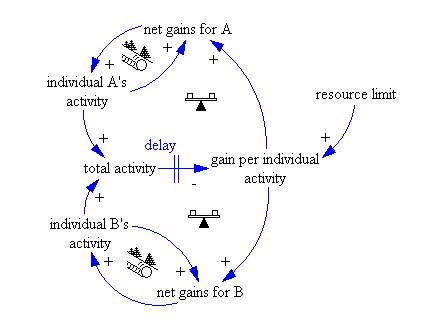
With such an incentive structure focused on the individual and without regulation, there is a rush to consume all resources (maximize per individual), leading to an eventual, inevitable total collapse.
One thing that has historically been a successful counterargument against these pessimistic trends is the idea that we should not underestimate human ingenuity and innovation (such as “The Ultimate Resource” by Julian Lincoln Simon). There are many examples where new scientific and technological progress developments (such as fracking) have changed predictions. Yet, even there are worrying trends that we might be approaching a plateau of discoveries in basic science.
It is a dangerous game to rely on technological progress only. We would be wise to remember that the purpose of life is not to win the game but to stay in it.
Resources
- Meadows, Donella H., et al. "The limits to growth." Green planet blues. Routledge, 2018. 25-29.
- Meadows, Donella H., Dennis L. Meadows, and Jørgen Randers. Beyond the limits: global collapse or a sustainable future. 1992.
- Meadows, Donella, Jorgen Randers, and Dennis Meadows. "A synopsis: Limits to growth: The 30-year update." Estados Unidos: Chelsea Green Publishing Company 381 (2004).
- Simon, Julian Lincoln. The Ultimate Resource. Princeton University Press, 1996.
- Degrowth Journal
- studyofprogress.org/models
- Her book, “Thinking in Systems” is a foundational read for anyone who wants to approach such complex topics from a more holistic perspective. ↩
- There are many criticisms of the model; I will cover them in a separate post. ↩
- There’s a fourth version, “2052: A Global Forecast for the Next Forty Years,” but it's different in approach from the rest, so I don’t include it here. It's a great read nonetheless, and I will review it separately. ↩