

Balance without a controller
Revisiting a classic model of simple rules and self-regulation
One thing I love about computers is that they let us run simulations. They also let us visualise complexity, learn visually and interactively, and run our own experiments. This is especially important when we investigate issues at the core of the challenges for progress, such as climate change.
In that spirit, let us revisit a classic system dynamics model, “Daisyworld”. It was created by Lovelock and Watson in 1983,1 with the goal of demonstrating how things in the natural world can look to be in balance without top-down conscious control.
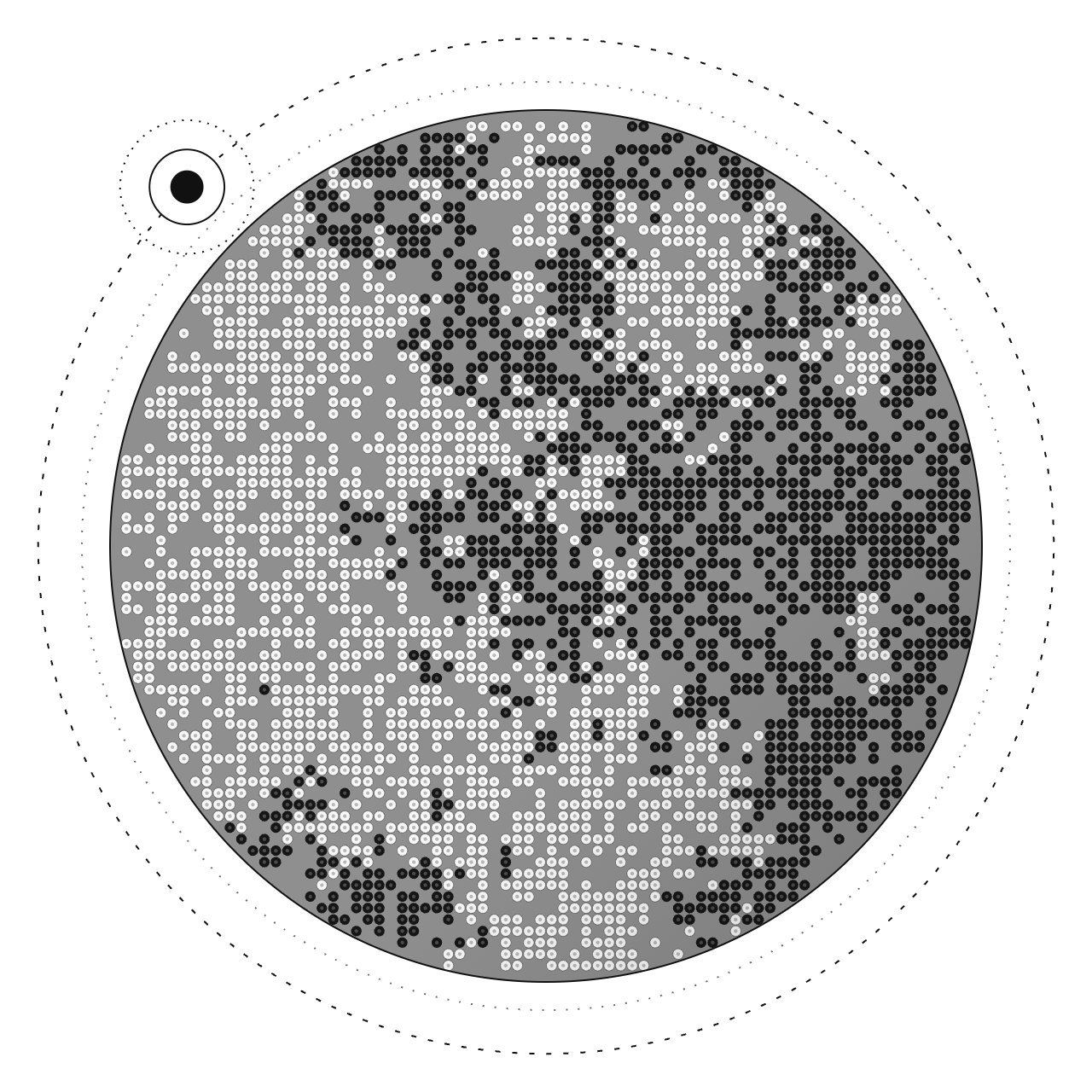
In the simulation a planet circles a sun that slowly becomes brighter. Two daisy species live on its surface, one black and one white. The bare ground reflects half of the light that falls on it, black daisies a quarter and white daisies three quarters, so a black daisy warms the ground it stands on and a white one cools it. The optimal temperature for both species is around 22.5 °C, and if it is different they grow less and can die out. Of course, neither species has any information about the overall system.
What happens as the sun keeps getting brighter? We will see that a planet without daisies just keeps getting warmer, but one with daisies stays in balance (Figure 1).
The original motivation for the work was to demonstrate Lovelock’s idea that life on Earth keeps the planet fit for life itself (the Gaia hypothesis). This drew significant criticism, especially from biologists, who argued that regulation on that scale would need foresight, and evolution has none.
We can summarise the mechanism in two loops. First, when the sun is dim and the planet still cold, only the black daisies stand on ground warm enough to grow. As they spread they absorb more light, which warms the planet and lets them spread even further, and so on. Eventually, when the sun becomes strong enough, the white daisies start to fare better. They spread, reflect more light and cool the planet. Each of these loops pushes the temperature of the planet towards one that suits both species, and this holds even as the sun keeps brightening.
My favourite part of the experiment is to make “grey” daisies. Give both an albedo of 0.5, so they have the same colour as the ground. They can grow and die in the same way as before, but they lose the capacity to change the climate in any way, and the result is a planet that behaves as if it were lifeless as the sun brightens. There is no correction mechanism left to stop the temperature from following the sun upward.
Like any real system, the daisies can only keep this balance within limits. They can only grow between 5 and 40 °C, so outside that range nothing survives. The figure below (Figure 2) shows how this works:
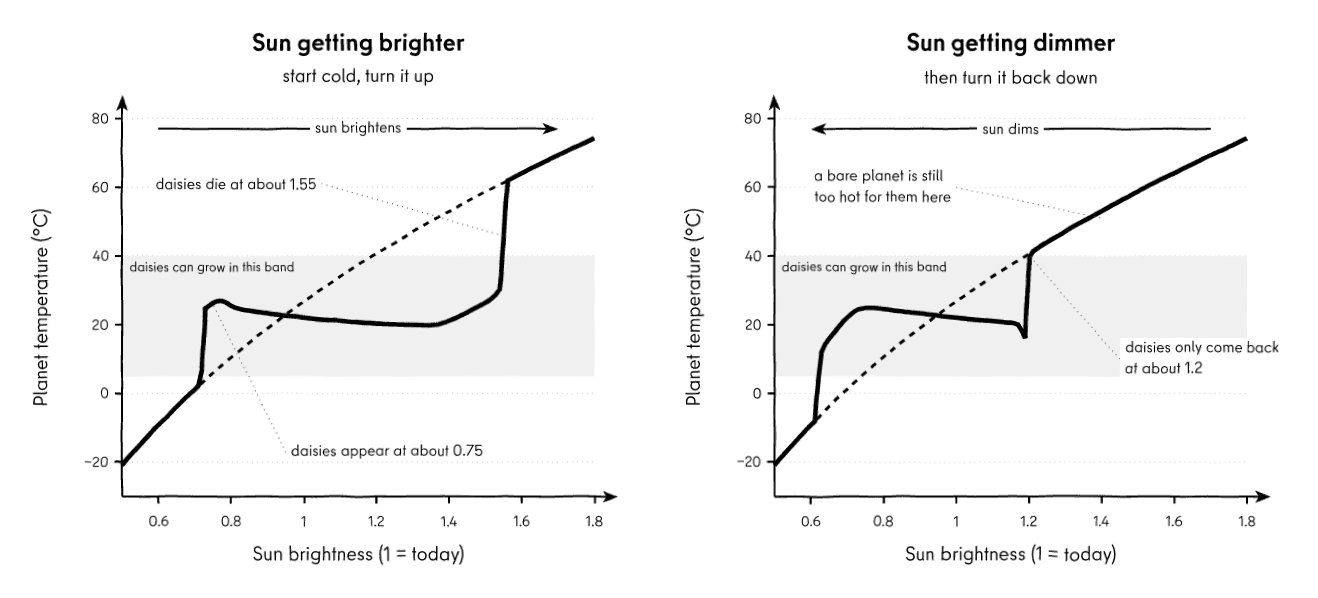
Start with a cold sun and turn it up slowly. At first the planet is too cold for daisies. At a sun of about 0.75 they appear and hold the temperature steady, until at about 1.55 it gets too hot even for the white ones, and the planet jumps to the temperature of a bare one. Now turn the sun back down. The daisies do not return at 1.55, because a bare planet is hotter than a living one, so they only come back when the sun is down to about 1.2. The same sun can therefore give a living planet or a dead one, depending on its history.
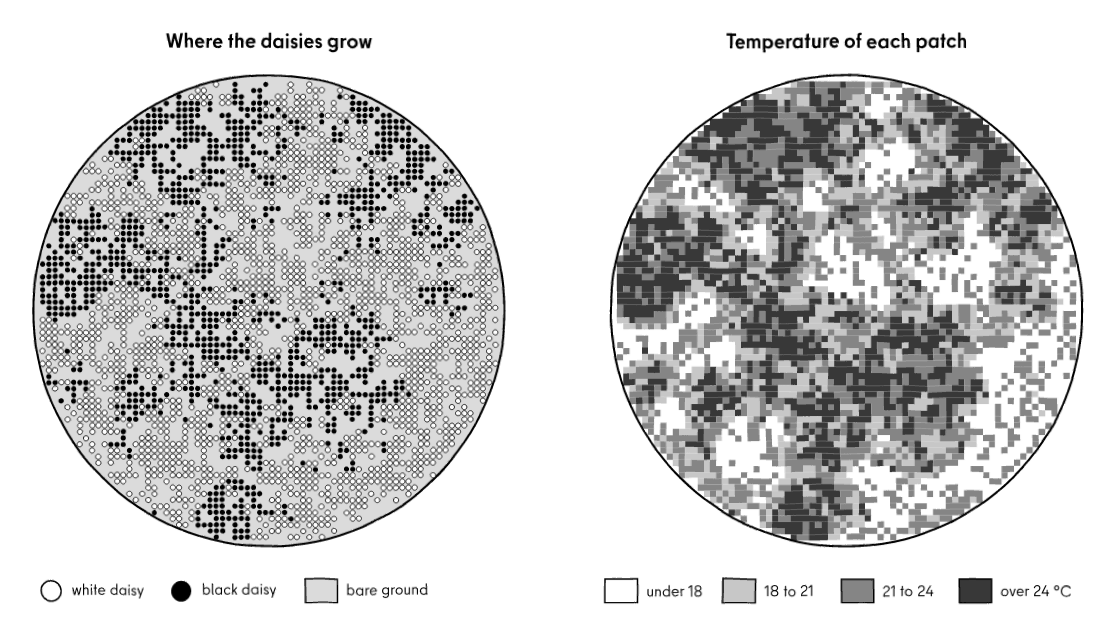
Another interesting thing is that the daisies, much like real plants, spread from their neighbours and tend to grow in clumps. This makes local climates and local weather, which constantly change, while the global temperature stays constant. The figure below (Figure 3) shows this:
This is an admittedly simple model, and real systems are far more complex. But it gives us intuition for how such systems work, and for why change is difficult but steering is possible.2 You can have a look at an interactive version of this experiment on my website, where you can play around with different parameters and get a deeper understanding.
References
1. Watson, A. J., & Lovelock, J. E. (1983). Biological homeostasis of the global environment: the parable of Daisyworld. Tellus B, 35(4), 284–289. ↩
2. Conant, R. C., & Ashby, W. R. (1970). Every good regulator of a system must be a model of that system. International Journal of Systems Science, 1(2), 89–97. ↩