

Between the Forest and the Trees
Why moving between levels of abstraction is now everyone's skill
The most important skill for a data and AI strategist is the ability to look at the forest and the trees simultaneously. I first explained this idea in my second book, Elements of Data Strategy,1 and I want to revisit it here. With generative AI entering (crashing into) knowledge work, we all need this skill now, not just the strategists.
The idiom “can’t see the wood for the trees” can be traced back to an old proverb collection by John Heywood, from the middle of the 16th century.2 The idea is that we need to pay attention to small details, such as daily tasks, and at the same time to the strategic level (i.e. why we are doing the work we do, how it affects others, and what the long-term plan for it is).
In the book I used a chess example (Figure 1). Experienced chess players are extremely proficient at looking at the game on several levels of abstraction. One is the individual pieces, which squares they control and what they directly affect. A second is the bigger parts of the board, where the “tensions” are, and the general advantages. Finally, they can combine both of these to make the best moves possible.
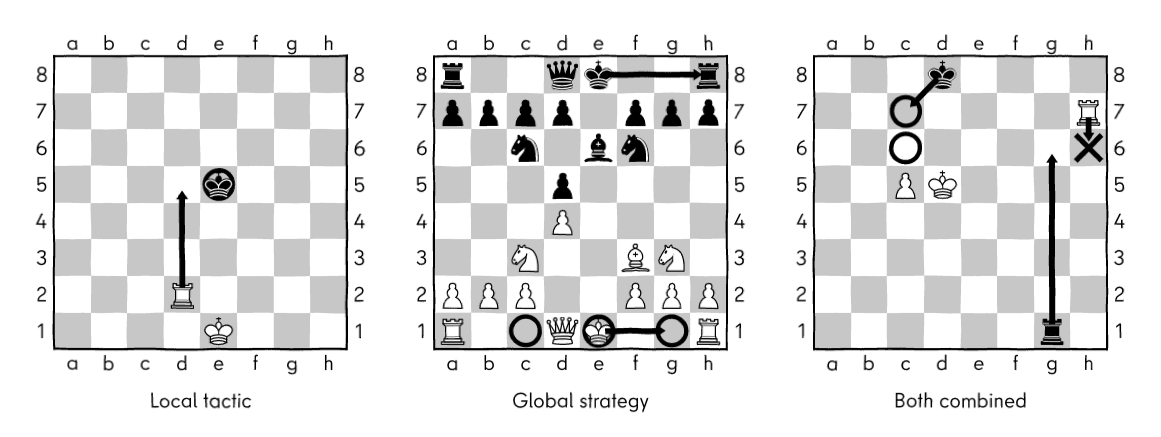
When we look at AI, it seems to be good at both ends of this abstraction stack. It is good at low-level details (such as writing code), but also at summarizing and planning. So what is left for us? I think it is the move between the two, deciding when to stop looking at the whole board and look at a single square, and when to step back again. AI does well at each level once you point it there. Knowing where to point it is still our job.
At the same time, the problems we face are becoming more and more complex. In The Architecture of Complexity, Herbert Simon describes the near-decomposability of complex systems.3 They are made of hierarchies of subsystems and sub-subsystems, and to understand them you always need to move between the different levels. The important word is near. Most of the time you can work on one part without thinking about the rest, which is what makes complex systems manageable at all, but the parts still interact, and that is usually where things go wrong.
Lisanne Bainbridge looked at how automation affects this, in her paper “Ironies of Automation” (1983).4 She showed that when automation takes over routine work, people are often called in for the edge cases, when something unexpected happens. Those situations require exactly this more holistic thinking. The irony is that the routine work was how operators kept their skills and their picture of the system up to date. Once the machine does it, the person called in for the hard case is less prepared than before. The same can happen to knowledge workers with AI. If we hand over the trees completely, we slowly lose the ability to judge the forest.
AI will only keep getting better at knowledge work, and I think this will push many of us back into being generalists (see David Epstein’s book Range).5 I also think this is inevitable. As the low-hanging fruit of knowledge work gets automated, we will be left with exceedingly “wicked” problems to deal with, in the sense Horst Rittel and Melvin Webber gave the word.6 Such problems have no definitive formulation and no point at which they are finished, and they are the kind where we'll need to move between levels.
References
1. Angelov, B. (2023). Elements of Data Strategy: A Framework for Data and AI-Driven Transformation. ↩
2. Heywood, J. (1546). A Dialogue Conteinyng the Nomber in Effect of All the Prouerbes in the Englishe Tongue. London. ↩
3. Simon, H. A. (1962). The architecture of complexity. Proceedings of the American Philosophical Society, 106(6), 467–482. ↩
4. Bainbridge, L. (1983). Ironies of automation. Automatica, 19(6), 775–779. ↩
5. Epstein, D. (2019). Range: Why Generalists Triumph in a Specialized World. Riverhead Books. ↩
6. Rittel, H. W. J., & Webber, M. M. (1973). Dilemmas in a general theory of planning. Policy Sciences, 4(2), 155–169. ↩