Against Universalism in the Study of Progress
Complex challenges require complex solutions
“The road to hell is paved with good intentions”.
Making decisions is crucial for citizens, employees, entrepreneurs, and government members. It is the most vital human faculty used to actualize ideas in our heads and bring them to the real world, hoping for a desired change. Unfortunately, decision-making has never been more challenging than in the 21st century. The exponentially rising complexity of the systems we need to interact with, manage, and design leads to a “fog of war” (uncertainty in situational awareness) that can even seep into our daily lives.
Here’s a simple example to provide us with intuition about these complex systems. Imagine you are taking a shower: you have two knobs at your disposal - one for hot water and another for cold. You must determine the optimal balance between releasing the two to achieve the desired temperature. This is a trial-and-error process for most of us (unless you get lucky with the first configuration). You gradually turn the knobs to almost arbitrary positions at the start, feel the effects on your skin, and then adjust accordingly, bringing the desired balance into fruition.
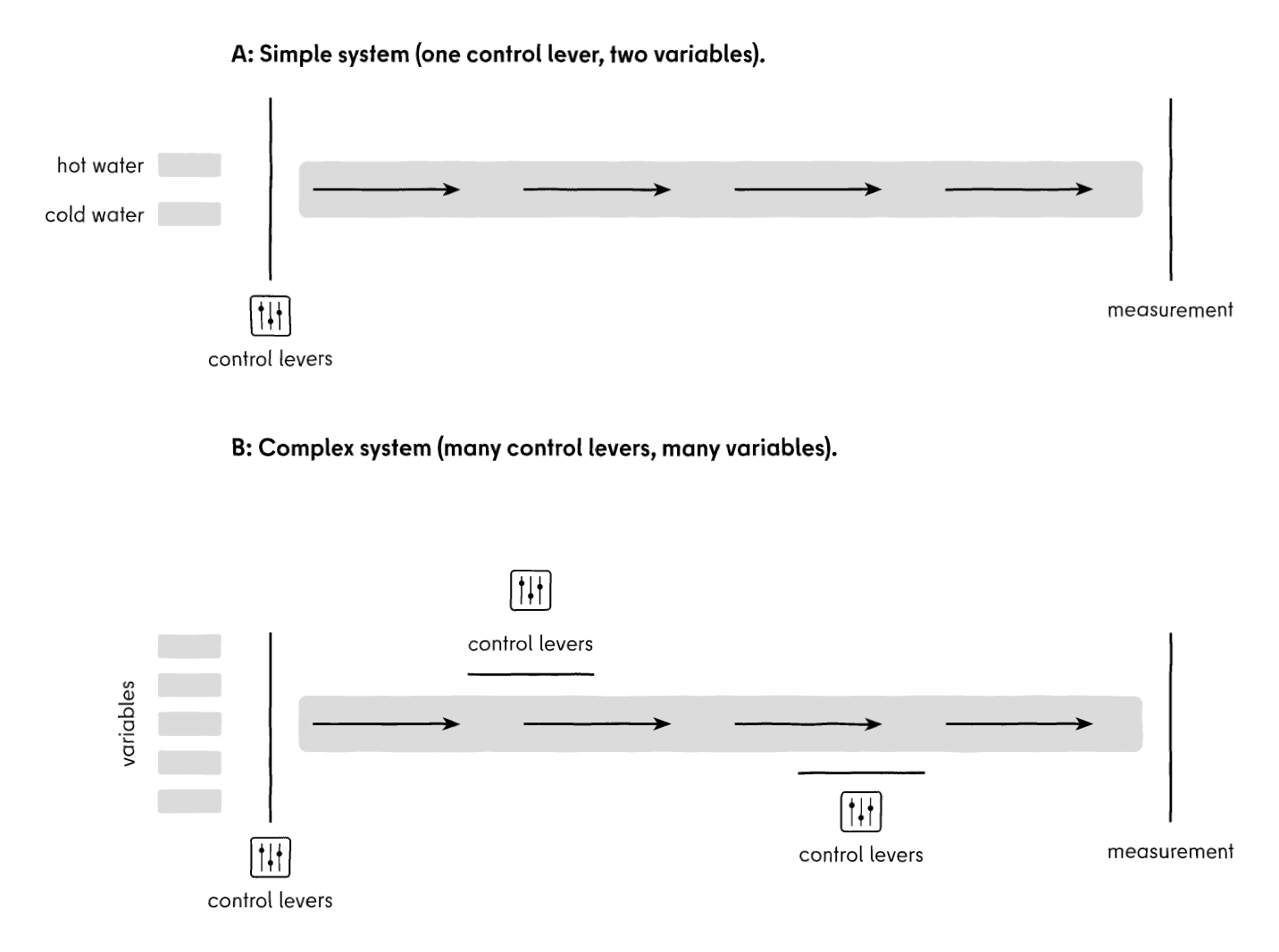
Now, why is this calibration often tedious (and potentially painful)? There are two main factors. First, you might be using a new shower or one you are not accustomed to (if you are at a hotel or visiting an old friend). And second, there is a delay between you turning the knobs and getting the signal from it. There will always be some time passing between the knobs and the water mixture coming out of the shower head, and you feel the results on your skin. By the same logic (and I am sure many have solid experiential evidence to support it), if the water pipe between the valves and the shower head is longer - the delay will also be longer, resulting in an even more annoying jostling of control valves. At some point, you will have to resign to make tiny adjustments, paying much more attention to the signals you collect and taking a long time to achieve an improved balance for the next iteration (which might take a while since delays make “overshooting”1 more common).
Complex systems are difficult to manage because they contain non-linear, hence often unpredictable, mechanisms of operation. The causal chains are longer and thus obfuscated to the outside.
This might seem like a contrived example, far from the real complexities of the world, but the pattern applies everywhere. Stafford Beer explained in his Manchester lectures how such feedback delays in gathering signals in the economy can lead even well-intentioned governments to take the worst possible action at the worst possible time. The consequences in such cases are much more severe than getting a burn from a hot water flow. Here is what he showed in one of the lectures:
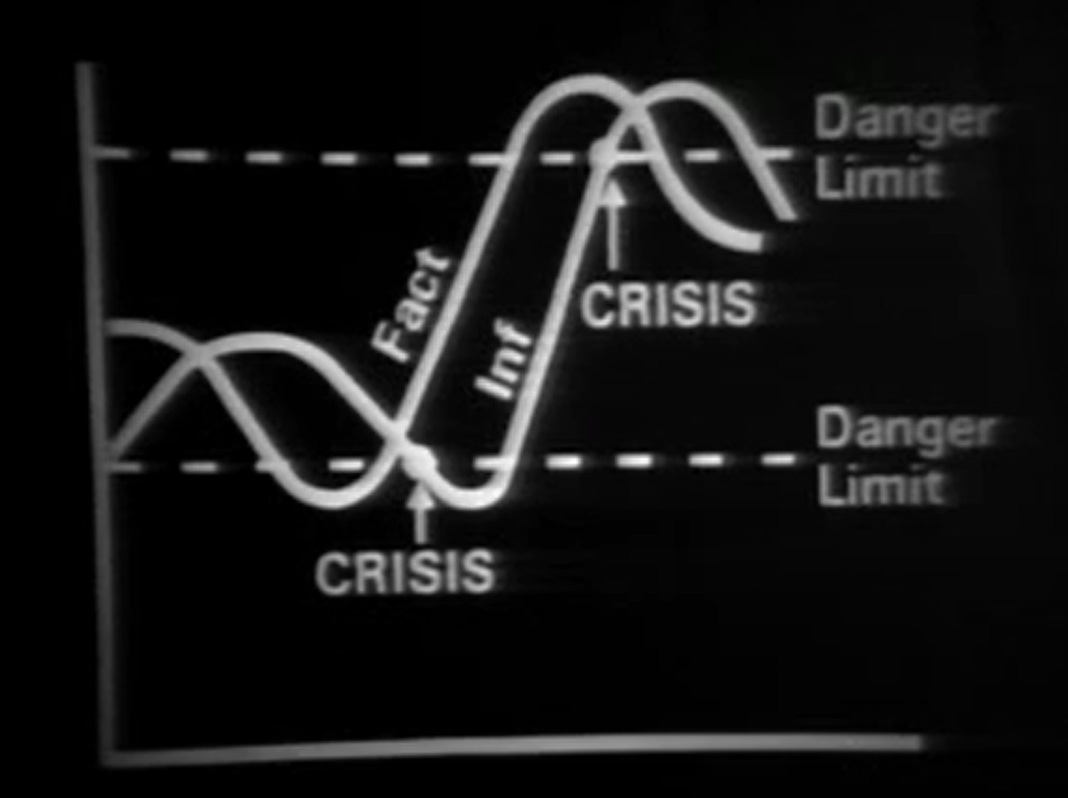
The delay is seen as the time passing between the “fact” and the “information” about the fact arriving at the hands of the decision-maker in a time of crisis.
There are many historical examples of how “simple” solutions were implemented, ignoring the complexities and context. In one example, the Prohibition era resulted in an explosion of organized crime. On the other side of the globe, the Soviet Union wanted to use the water from the Aral Sea for irrigation but failed spectacularly, resulting in a complete ecological collapse (many geoengineering approaches are also bound to fail for the same reason).

We must match the complexity of the problems we face with the complexity of our approaches.2 In his recent collection of essays, Slavoj Žižek wrote:
“Whatever form it takes, progress is encountered as an idea in crisis. It is a concept at war with its own foundations in the reason of the Enlightenment and the imperialism that underpinned even Karl Marx’s formulations of human historical teleology, embattled by Western neo-liberal notions of the ‘end of history’. Progress has to be encountered as fragmented, partial and perpetually undermining the universalist pretensions that once formed its very core.” - Slavoj Žižek (“Against Progress”)
The first step in deciding on a complex environment is realizing that it is complex; there are no shortcuts, and we must tread lightly. We must always be wary of universalism, even more so in progress studies. Different countries and cultures have their own sets of challenges and capabilities, even if the fundamental goals of social, economic, and technological progress are similar. Innumerable solutions are available locally, with many doing wonders in one country’s economy while wreaking havoc in another, hinting that globally universal policies for progress might be the last thing we should try.
Resources
- Angelov, Boyan. “Managing the Century of Complexity: Origins, Evolution and Productive Future Avenues with Systems Thinking.” OSF Preprints, 2022
- McGirr, Lisa. The war on alcohol: Prohibition and the rise of the American state. WW Norton & Company, 2015.
- Micklin, Philip. "The Aral Sea disaster." Annu. Rev. Earth Planet. Sci. 35, no. 1 (2007): 47-72.
- Žižek, S.. Against Progress. Bloomsbury Publishing, 2024