A Century of Stafford Beer
Celebrating the life and work of one of our greatest thinkers
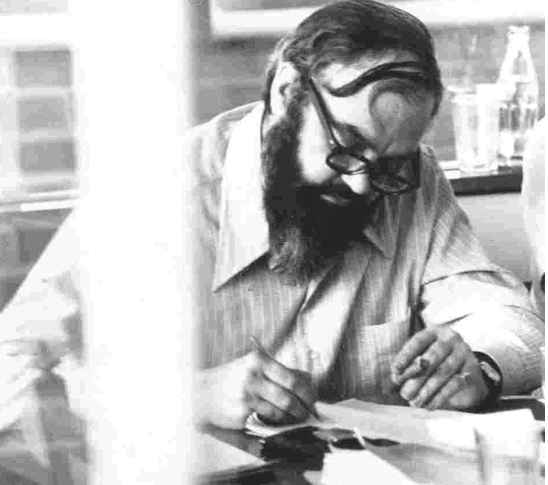
This year we celebrate a hundred years since the birth of one of the most original and groundbreaking thinkers of the last century. Someone who defined a whole new field, and found himself in one of the most pivotal events in history, the Chilean revolution and the brief years of Salvador Allende’s government (brilliantly captured by Patricio Guzmán’s El primer año film). We are, of course, talking about Stafford Beer, the father of management cybernetics and operations research.
Influence on progress studies
In his time time the term was not coined yet, of course, and I am also not sure how he would even feel about the word “progress”. But his first principles understanding of systems and complexity becomes a key cornerstone in our toolbox to address the root obstacle of progress: the complexity of the systems we are part of, design and manage. On all accounts he was committed to the betterment of our world. In one quote, the famous artist and activist Brian Eno describes him:
“He saw in cybernetics a resolution of his spiritual and scientific personalities, a way of turning science towards the liberation of humanity.”
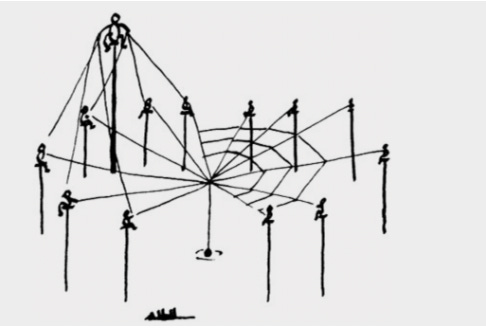
In his many works he recognised the growing challenges that complexity poses for us, whether in our governments, industries or healthcare systems. One look at a drawing from Designing Freedom illustrates that:
I came across Beer’s work very early in my literature research on progress and complexity several years ago. His involvement in Chile was mentioned in Utopia for Realists. This led me into a rabbit hole of research, starting from listening to Eden Medina’s talk at a tech data conference, and reading her book Cybernetic Revolutionaries. At that point I commenced to devour his books, such as Brain of the Firm. They made a lasting impression on me with the multitude of drawings, diagrams, and even poetry; all tools for him to make us rethink how we deal with complex systems. If I could summarise all his thinking in a sentence (a blasphemous exercise of reductionism) it would be in his own words (with a minor context addition):
“The purpose of a system is what it does [and not what it is intended to do].”
Eventually, I had the opportunity to attend and present some of my ideas on progress at the Metaphorum conference in 2024 in Berlin1, where I met many of his friends and collaborators, seeing first hand how his methods, are still thriving in applications around the world today.
Early life and career
Beer was born in London on the 25 September 1926, in an educated household, with his father being a Chief Statistician (an inspiration to what is to come later in his life). He had to drop out of UCL’s philosophy department to serve in the British Army, before returning after the war to work in operation research. Eventually he led an research group at United Steel and then established his own consulting practice called SIGMA, where his first connections to South America began to take root.
Project Cybersyn
Somewhat serendipitously, Beer got a call from Chile from Fernando Flores (another fascinating person who went on to research symbolic AI with Terry Winograd) and was persuaded to ditch everything for a grand new challenge: to implement his ideas on a country-wide scale. The task was to apply cybernetics and technology to help manage the economy; in a project to be named Cybersyn.
The infrastructure behind it consisted of a network of telex machines, spread throughout the country, connected to the central government computer, recording and transmitting real-time information of factory production data. The central computer served as a “dashboard”, and was modelling software, detecting anomalies. Beer wanted a real-time information system, designed to enable viable economic management through a foundation of cybernetic principles. The word viable is key here, since probably his most famous contribution was the creation of the Viable System Model (VSM), used to model any viable (autonomous) system. This model can be used to diagnose the system and provide improvements to make it more capable of surviving in complex and changing environments.
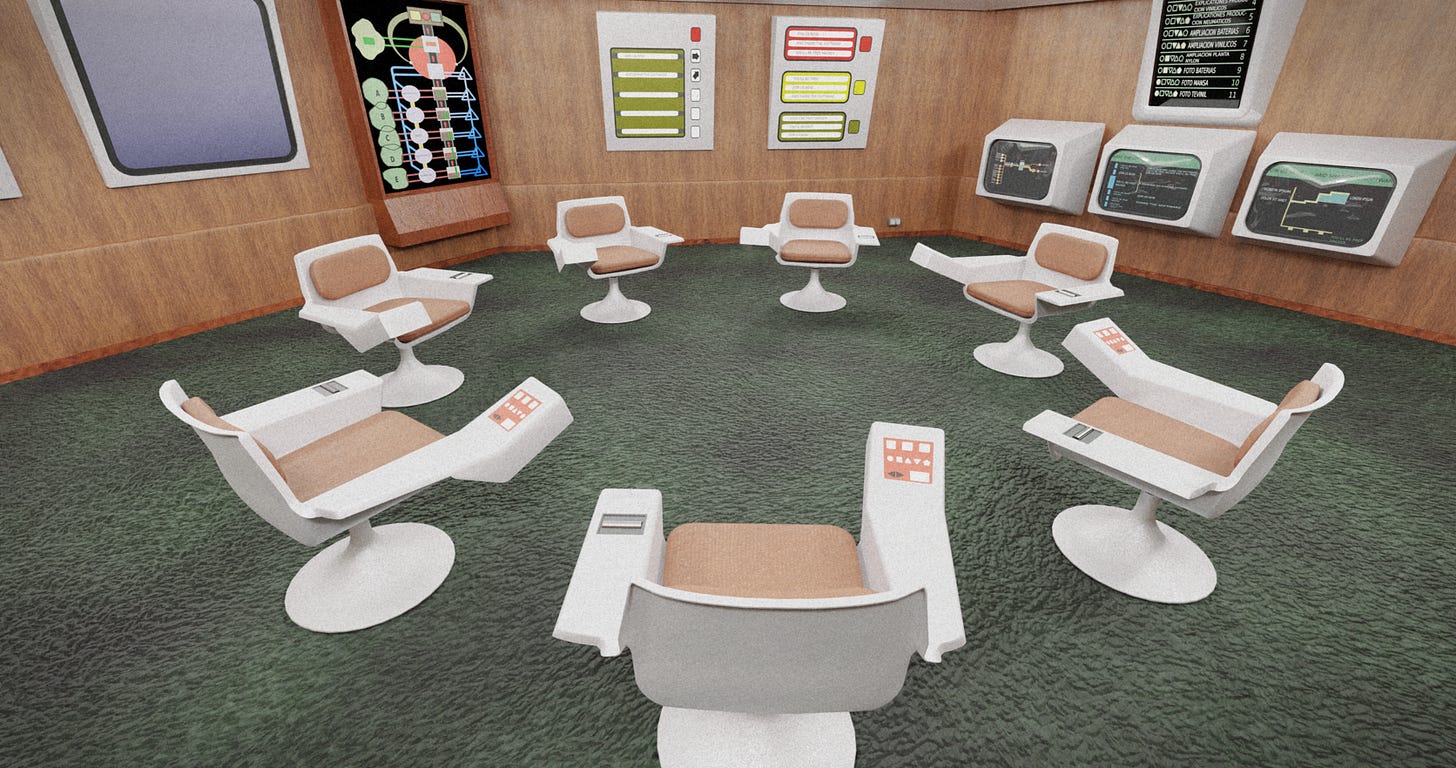
The completed project was designed with several modules in mind. First, Cybernet (the telex-based network for gathering and transmitting data from the factories to the central system). Then, Cyberstride (software to perform statistical analysis, and provide early warnings), CHECO (economic simulations), and most famously perhaps, the “Operations Room” (pictured above). The latter was to be the central control center, a dashboard of source where human managers can analyse the incoming data in real-time, implement interventions and monitor alerts. Unfortunately, the project was cut short due to the coup d'état in 1973, and Beer together with many of his collaborators had to leave the country to avoid repression.
Later work
Beer continued to consult governments, such as the URICIB system in Uruguay, also in Columbia. Other efforts were more challenging, often limited by local corruption or economic, political or social instability. In the decades that followed he published many more books, such as Platform for Change and The Heart of the Enterprise, and continued to lecture and teach worldwide. Beer was an excellent communicator; have a look at him explaining a key cybernetic concept, Feedback:
As Rob Passmore wrote in the obituary on openDemocracy (aptly titled The Man Who Could Have Run the World):
“Stafford Beer achieved the hardest of all pedagogic tasks: he changed the way people think. His protean influence stretches from generations of inspired students […] A huge, life-affirming figure has passed, but his work will long survive […]”.
The century of complexity needs us to rethink our way of life, if we are to steer into a balanced version of progress, one of both abundance and justice. Beer’s thinking will be there to guide us.
Thank you, Stafford Beer.
Bibliography
- Medina, Eden. Cybernetic revolutionaries: Technology and politics in Allende's Chile. Mit Press, 2011.
- Bregman, Rutger. Utopia for realists. Bloomsbury Publishing, 2018.
- Beer, Stafford. Designing freedom. House of Anansi, 1993.
- Beer, Stafford. Brain of the Firm. John Wiley & Sons, 1995.